What to Do When Your Website Is Not Generating Leads
A diagnostic sequence for established service businesses whose website gets visits but produces too few qualified conversations.
Who this is for
Owners of established B2B or high-value service businesses with a real offer, some traffic or reputation, and a website that is not creating enough qualified demand.
You do not need generic advice to redesign everything. You need to identify whether the constraint is traffic, message, proof, offer, conversion, follow-up, or measurement before spending again.
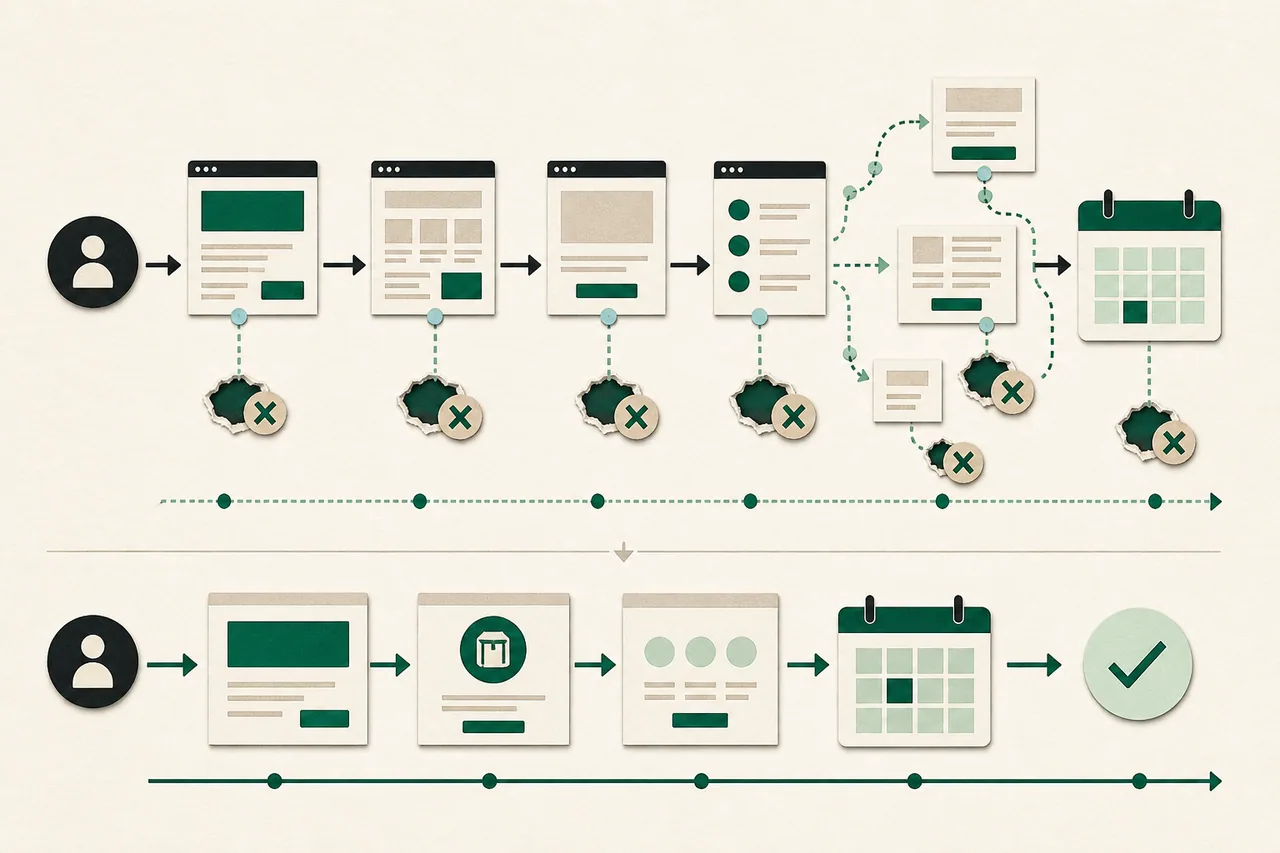
The short answer
Verify measurement, segment the traffic, test whether the right buyer recognizes their problem and next step, inspect form and follow-up reliability, then improve the strongest bottleneck rather than repainting the whole site.
What to do in the first hour
- 1.Submit every lead path yourself on phone and desktop. Confirm the user sees success, the lead reaches the right system, an owner is notified, and the reply process works.
- 2.Compare a recent period's analytics conversions with actual CRM or inbox leads. Reconcile counts before trusting a conversion rate.
- 3.Separate traffic by source, intent, geography, device, and landing page. Ten referral visits from ideal buyers and ten thousand irrelevant impressions are not the same opportunity.
- 4.Write the sentence an ideal buyer should understand in five seconds: who this is for, what costly situation you solve, and what useful next step they can take.
Diagnose before you buy another solution
A traffic problem means the right buyers are not arriving. A message problem means they arrive but do not recognize themselves. An offer problem means the promised next step feels vague, risky, or mismatched to their buying stage.
A trust problem means claims exceed proof or the site hides the person, process, limits, and ownership buyers need to evaluate. A conversion problem may be broken forms, slow pages, confusing navigation, mobile friction, or premature requests for too much information.
A follow-up problem happens after conversion: notifications fail, replies are slow, sales asks for context the form already collected, or nobody owns the lead. Fixing page copy cannot repair a broken handoff.
A practical recovery plan
Choose one audience and costly moment
Write for a specific established buyer in a specific situation, such as an owner whose developer disappeared or whose manual intake loses work. Explain why the page is for them and who should not use it.
Make the offer concrete
Describe the first useful outcome, what the buyer provides, what they receive, what uncertainty is reduced, and what happens next. A smaller diagnostic step can be more credible than asking a cold visitor to buy a large transformation.
Build proof without theater
Use specific work, demonstrated systems, clear process, relevant credentials, constraints, and honest examples. Do not invent client metrics or anonymous testimonials. If proof is thin, show judgment through useful analysis.
Reduce decision friction
Use plain navigation, readable pages, one primary action, direct calendar expectations, accessible forms if needed, and useful answers about fit, cost range, ownership, security, and timing. Remove competing lead magnets that serve no buying decision.
Run a focused measurement cycle
Track qualified calendar bookings and completed handoffs by landing page and source. Review search queries and sales language. Improve the page receiving the clearest qualified intent before producing dozens of broad articles.
Questions to ask before approving more work
- Which exact audience and buying moment is this page meant to serve?
- Can we prove the lead path works from submission through human response?
- What evidence supports the promise without inventing outcomes?
- Which page and source create qualified conversations, not merely traffic?
- What is the single next action and what should the buyer expect after it?
Red flags
- — A redesign is proposed without funnel and lead-delivery verification.
- — SEO success is defined as publishing volume or impressions alone.
- — The homepage lists every capability for every possible buyer.
- — Calls to action compete across chat, newsletter, download, form, phone, and calendar.
- — Conversion claims rely on analytics events that were never reconciled to real leads.
When to bring in specialist help
Use qualified accessibility, privacy, advertising, or legal guidance where your market requires it. If traffic collapsed suddenly, verify indexing, analytics, domain, security, and deployment incidents before treating the problem as copywriting.