Custom Software vs. SaaS: What Should Your Business Choose?
A decision framework for established businesses deciding whether to buy software, customize existing tools, integrate them, or build a focused system.
Who this is for
Owners and operators with a valuable workflow that off-the-shelf tools support poorly, but who want to avoid an unnecessary custom-software project.
The best decision depends on strategic differentiation, workflow stability, switching cost, data control, integration needs, and lifetime ownership—not whether custom software sounds impressive.
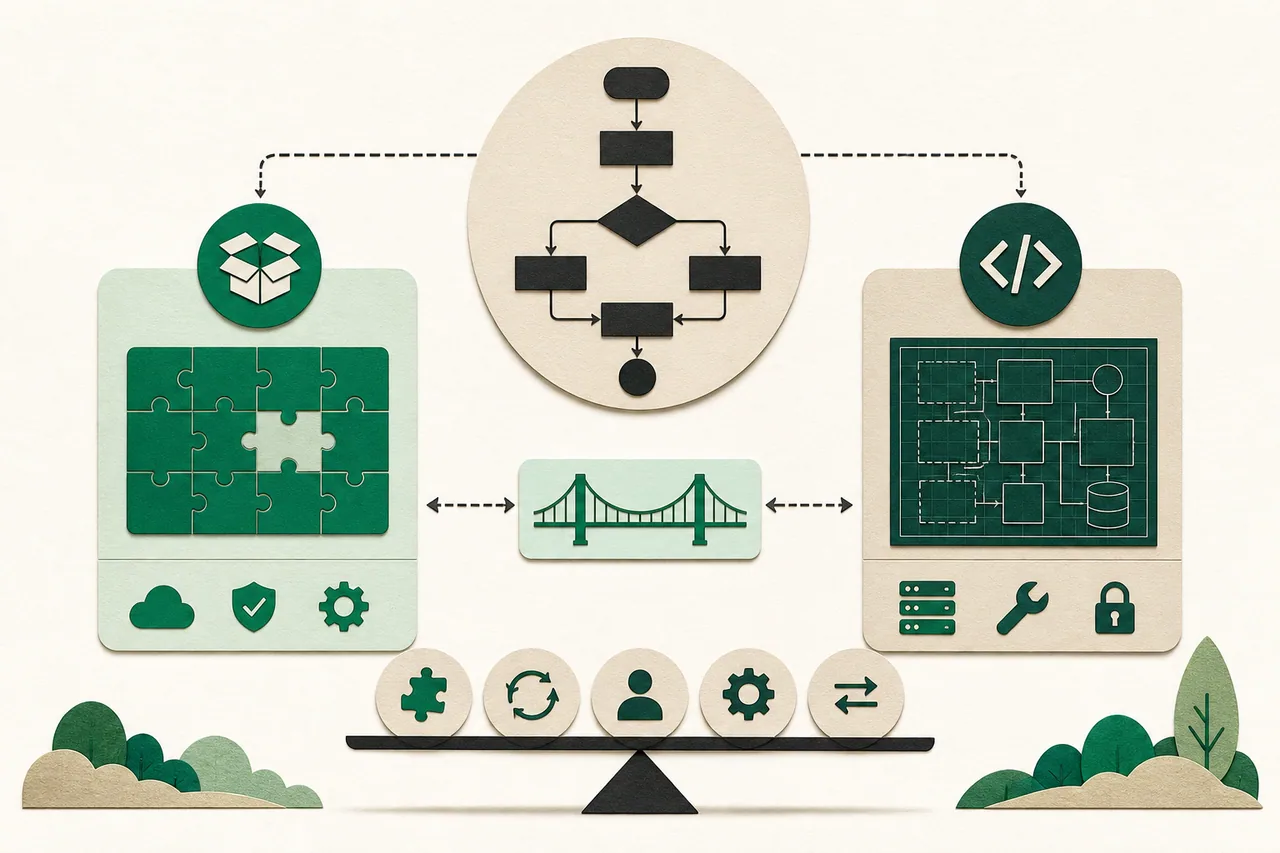
The short answer
Buy the commodity and build the differentiator. Start with the business constraint, test configuration and integration options, model total ownership, and use custom code only where it creates durable value or removes a costly operational limit.
What to do in the first hour
- 1.Name the workflow and business outcome, not a desired product category. Describe users, volume, exceptions, data, approvals, integrations, and current cost.
- 2.Separate commodity needs such as accounting, payroll, identity, email, and payments from the workflow that actually differentiates your customer experience or operating model.
- 3.List existing tools already paid for and inspect their native features before adding another platform.
- 4.Set a decision deadline and a small research budget so software shopping does not become a six-month avoidance project.
Diagnose before you buy another solution
Choose SaaS when the process is common, requirements are broadly shared, vendor reliability and compliance exceed what you can economically build, and changing your process is cheaper than owning software.
Choose configuration or integration when existing tools contain the required capabilities but information or handoffs are fragmented. Beware that a web of connectors can become custom software without a coherent owner.
Consider a focused build when the workflow creates meaningful advantage, required behavior is stable enough to specify, off-the-shelf workarounds impose persistent cost or risk, and the business can fund ongoing operation—not only initial development.
A practical recovery plan
Create weighted decision criteria
Rank must-have workflow fit, data ownership, permissions, integration, reporting, reliability, implementation effort, vendor stability, exit options, and five-year cost. Weight the few criteria that actually change the decision.
Test with a real scenario
Ask vendors or builders to demonstrate your hardest representative case using sample data. Generic feature tours hide the exact handoff, exception, or permission that will later require expensive workarounds.
Model total ownership
Include licenses, implementation, customization, integrations, training, support, internal administration, upgrades, migration, downtime, backups, compliance, and exit. For custom software include product decisions, QA, hosting, monitoring, security, and maintenance.
Prefer a hybrid boundary
Keep commodity functions in maintained platforms and build a thin workflow or customer experience around stable APIs when that adequately creates advantage. Avoid copying entire CRMs, billing systems, or identity platforms into custom code.
Plan the exit before entry
Confirm data export formats, API access, account ownership, termination obligations, source ownership, documentation, and migration options. Vendor lock-in and developer lock-in are both operating risks.
Questions to ask before approving more work
- Which requirement creates business advantage versus personal preference?
- Can a native feature or process change remove the need to build?
- What happens to our data and workflow if the vendor changes price or closes?
- Who operates and improves a custom system after launch?
- Which small experiment would invalidate our favorite option?
Red flags
- — A builder recommends custom software before examining tools you already own.
- — A vendor demo avoids your real exception and shows only prepared sample data.
- — The comparison uses license cost versus build cost but excludes ongoing ownership.
- — Integration is assumed because both products list an API.
- — The decision is driven by frustration with a temporary setup problem.
When to bring in specialist help
Get specialist review for regulated data, payment flows, identity, safety, data residency, contractual portability, and high-volume performance. A business decision framework helps structure the choice but does not replace domain compliance work.