How to Stop Leads From Falling Through the Cracks in Your CRM
A business-owner checklist for finding and fixing lost inquiries, slow follow-up, duplicate records, and unreliable lead handoffs.
Who this is for
Established service businesses with enough inbound demand to matter but no trustworthy view of whether every qualified lead receives timely ownership and follow-up.
The problem is rarely a missing CRM feature. It is usually an unclear process, disconnected intake channels, weak ownership, or automation that reports success without producing a sales action.
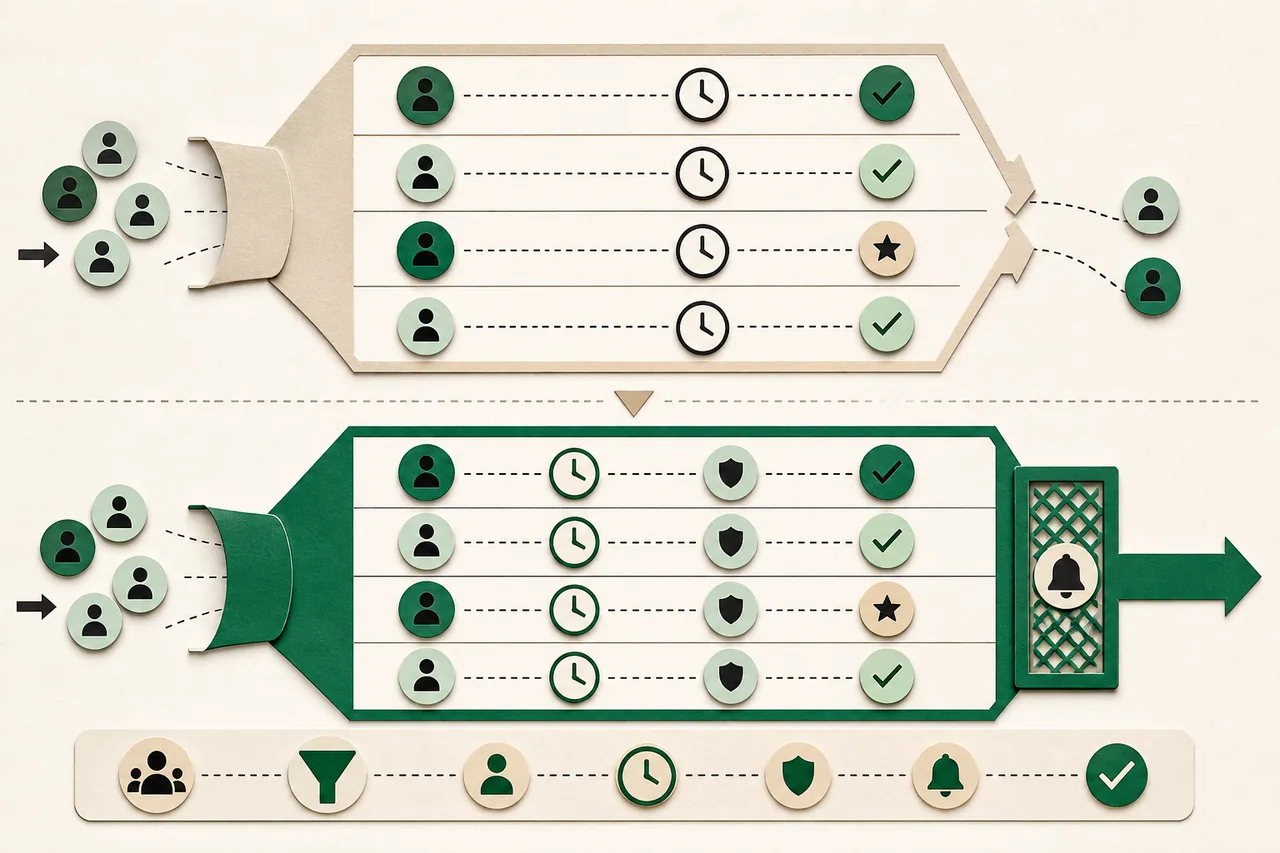
The short answer
Define the lead promise, reconcile every intake source against the CRM, assign one owner and deadline, make exceptions visible, and measure stage movement before buying more software.
What to do in the first hour
- 1.List every place a lead can arrive: website forms, calls, chat, email, ads, referrals, marketplaces, events, and direct messages.
- 2.Select a recent week and reconcile source submissions against CRM records and first responses. Record missing, duplicate, late, and unassigned examples.
- 3.Define what counts as a lead, a qualified lead, a response, and an accepted handoff. Otherwise dashboards will disagree honestly.
- 4.Assign a temporary human owner to review exceptions daily while the system is repaired.
Diagnose before you buy another solution
Lead leakage occurs before the CRM when a form fails, during identity matching when records duplicate, after creation when nobody owns the record, or later when stages and tasks stop reflecting reality.
Separate capture reliability from sales performance. First prove every valid inquiry arrives with the required context and an owner. Then evaluate response speed, qualification, follow-up quality, and conversion.
Trace five real leads, including one duplicate, one unqualified inquiry, and one after-hours submission. Follow the timestamps through source, automation, CRM, assignment, notification, response, and outcome.
A practical recovery plan
Write the lead service level
State which inquiries deserve response, the maximum response time by channel and business hours, who owns first contact, required follow-up attempts, and when a lead can be closed. Keep it short enough that staff can use it.
Choose a system of record
The CRM should hold the durable lead identity, owner, stage, next action, and outcome. Other tools may collect or communicate, but they should not each maintain competing truth without a reconciliation rule.
Make assignment deterministic
Use explicit territory, service, availability, or rotation rules. Store why a lead was assigned and provide a visible unassigned queue. Avoid notifications to a group with no single accountable owner.
Monitor exceptions
Create views for valid inquiries missing from CRM, unassigned leads, overdue first response, no next task, stage age, duplicate identities, and failed integrations. Review exceptions before celebrating aggregate volume.
Close the measurement loop
Capture qualified status, reason lost, revenue outcome, source, and time-to-first-human-response using definitions staff can apply. Use samples to audit data quality; a beautiful dashboard built on skipped updates is worse than a small reliable report.
Questions to ask before approving more work
- Can we reconcile every intake source to CRM creation for a specific date range?
- Who owns a lead at each point, including nights, vacations, and reassignment?
- What happens if the same person submits twice through different channels?
- Which alert indicates a real exception and who acts on it?
- Can we explain the denominator behind our response and conversion rates?
Red flags
- — The proposed solution is a CRM migration before anyone audits the current handoff.
- — A group inbox or Slack channel is treated as ownership.
- — Automated confirmation is counted as a sales response.
- — Source attribution overwrites itself, making later reporting impossible to explain.
- — Staff are blamed for missing fields that the workflow makes burdensome or ambiguous.
When to bring in specialist help
Review consent, recording, messaging, and data-retention requirements with qualified counsel for your locations and channels. If lead data includes sensitive information, limit collection and access rather than copying it into every sales tool.